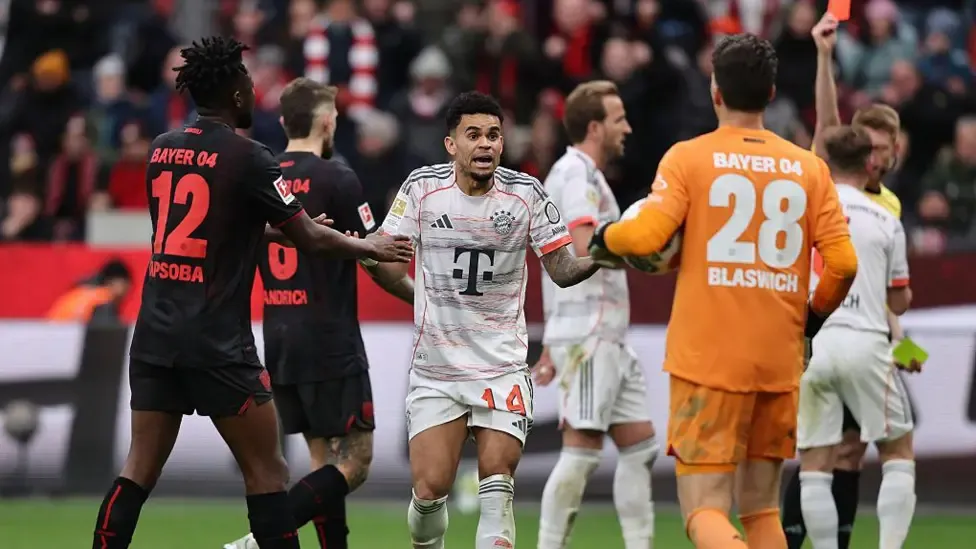
German champions Bayern Munich demonstrated resilience after finishing the match with nine players yet securing a hard-fought 1–1 draw against Bayer Leverkusen in a high-intensity clash in the Bundesliga. The encounter highlighted Bayern’s defensive discipline and mental strength despite severe numerical disadvantage following two red cards. Leverkusen, widely regarded as one of the league’s most tactically sophisticated teams, controlled possession for long stretches but struggled to convert pressure into a decisive result. The outcome reflects the competitive intensity at the top of German football, where even the smallest tactical adjustments can determine the balance of power.
A Dramatic Bundesliga Encounter
A fiercely contested fixture in the Bundesliga saw Bayern Munich and Bayer Leverkusen share points after an absorbing 1–1 draw. The match unfolded with intense tactical battles and dramatic momentum shifts, ultimately leaving Bayern to defend with only nine players for a significant portion of the contest.
Despite the numerical disadvantage, the Bavarian club displayed remarkable resilience, preserving the draw through disciplined defending and strategic game management.
Bayern’s Defensive Resilience Under Pressure
The defining narrative of the match was Bayern’s ability to maintain composure after two players were sent off, reducing the team to nine men. Playing with such a disadvantage typically places enormous strain on defensive organization and physical endurance.
Yet Bayern Munich adapted swiftly, reshaping their formation to prioritize defensive solidity. The team narrowed its structure, limiting Leverkusen’s space in attacking zones and forcing the opposition into low-probability scoring attempts.
This tactical discipline underscored Bayern’s experience in managing high-pressure situations, a hallmark of elite European clubs.
Bayer Leverkusen’s Tactical Control
For Bayer Leverkusen, the match offered an opportunity to capitalize on numerical superiority. The team dominated possession and attempted to stretch Bayern’s reduced defensive line through rapid ball circulation and wide attacking movements.
Leverkusen’s tactical structure allowed them to create several promising attacking sequences. However, converting these chances proved difficult against Bayern’s compact defensive setup and determined goalkeeping performance.
The inability to secure a winning goal highlighted the challenge of breaking down well-organized defensive units—even when holding a numerical advantage.
Implications for the Bundesliga Title Race
The draw has broader implications for the competitive landscape of the Bundesliga. With both clubs positioned among the league’s top contenders, every point carries strategic importance in the title race.
For Bayern Munich, earning a point under such challenging circumstances reinforces the team’s reputation for resilience. Meanwhile, Bayer Leverkusen may view the result as a missed opportunity to gain a stronger foothold in the standings.
The match reflects the increasingly competitive nature of German football, where tactical precision and mental endurance often determine outcomes.
A Testament to Competitive Balance
Beyond the immediate result, the contest served as a compelling reminder of the unpredictable nature of top-tier football. Even with numerical disadvantages and shifting momentum, elite teams can adapt strategically to preserve results.
For supporters and analysts alike, the draw between Bayern Munich and Bayer Leverkusen illustrates why the Bundesliga remains one of Europe’s most captivating leagues. As the season progresses, encounters like this will continue to shape the narrative of a fiercely contested championship race.
Comments