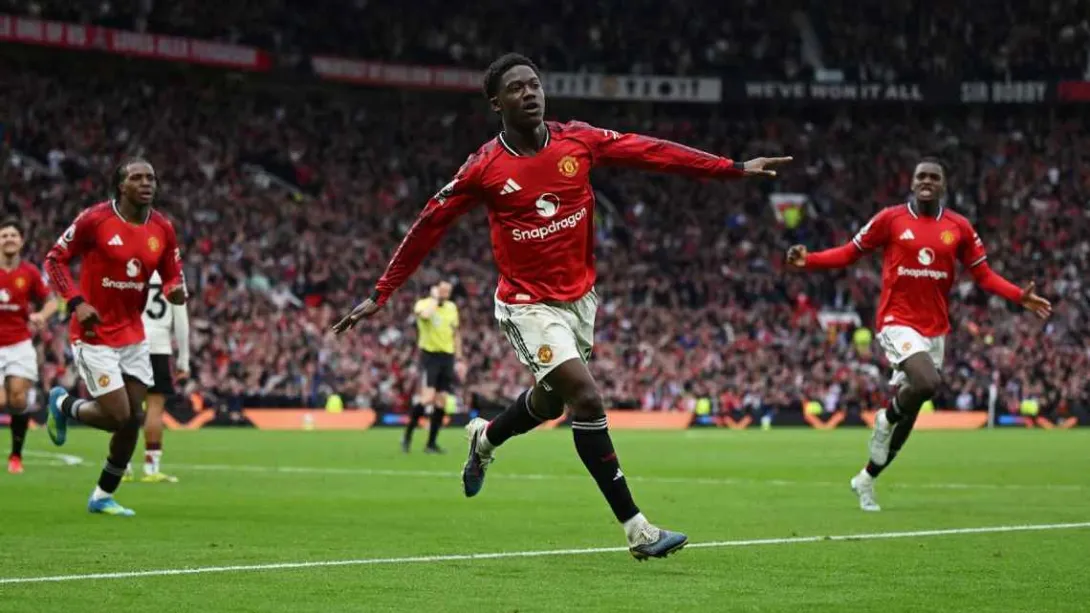
Michael Carrick strengthened his credentials as a leading managerial contender after guiding Manchester United to a crucial 3-2 victory over Liverpool, sealing qualification for the UEFA Champions League. Since assuming interim charge in January, Carrick has accumulated 32 points from 14 matches, a return that has elevated him as the frontrunner for the permanent role. His calm leadership and tactical discipline have reinvigorated the club’s campaign, positioning United for a return to Europe’s elite competition and reshaping internal discussions around long-term managerial stability.
Decisive Victory at Old Trafford
Manchester United delivered a statement performance at Old Trafford, overcoming Liverpool in a tightly contested 3-2 encounter. The result not only carried historic rivalry significance but also confirmed United’s place in next season’s UEFA Champions League.
Facing a Liverpool side led by Arne Slot, United demonstrated resilience and attacking efficiency. The narrow margin reflected the intensity of the contest, with both teams pushing for dominance in a high-stakes fixture.
Carrick’s Impact Since January
Since stepping in to replace Ruben Amorim in January, Carrick has orchestrated a notable turnaround. His tally of 32 points from 14 matches represents a strong performance trajectory, particularly given the mid-season transition.
Carrick described his leadership role as “natural,” signaling both confidence and familiarity with the club’s internal dynamics. A former United midfielder, he has leveraged institutional knowledge and tactical awareness to stabilize the squad during a critical phase of the season.
Tactical Stability and Dressing Room Confidence
Under Carrick’s interim stewardship, United have exhibited greater tactical cohesion and defensive organization. His approach has emphasized balance—combining structured defending with calculated attacking transitions.
Equally significant has been his ability to command respect within the dressing room. Managing a high-profile squad often requires nuanced leadership, and Carrick’s understated style appears to have fostered a sense of unity and clarity among players.
Financial and Strategic Implications of Qualification
Securing Champions League qualification carries substantial financial benefits. Participation in Europe’s premier club competition can generate revenues through broadcasting rights, sponsorships, and matchday income, often amounting to hundreds of millions in aggregate value.
For Manchester United, this qualification not only strengthens its financial outlook but also enhances its attractiveness to elite players and commercial partners. In this context, Carrick’s success has broader implications, influencing both sporting and business strategy.
A Strong Case for Permanent Appointment
Carrick’s record has inevitably positioned him as the leading candidate for the full-time managerial role. His ability to deliver consistent results under pressure, coupled with his deep understanding of the club’s culture, strengthens his case.
While the final decision will depend on long-term strategic considerations, his interim tenure has already reshaped perceptions. What began as a temporary assignment now appears to be a defining audition for one of football’s most scrutinized managerial positions.
Looking Ahead
As Manchester United prepares for its return to the Champions League, the club faces a pivotal decision regarding leadership continuity. Carrick’s performance has provided both stability and momentum, key ingredients for sustained success.
In modern football, where managerial tenures are often short-lived, his measured rise offers a compelling narrative—one that blends experience, opportunity, and results into a credible blueprint for the future.
Comments