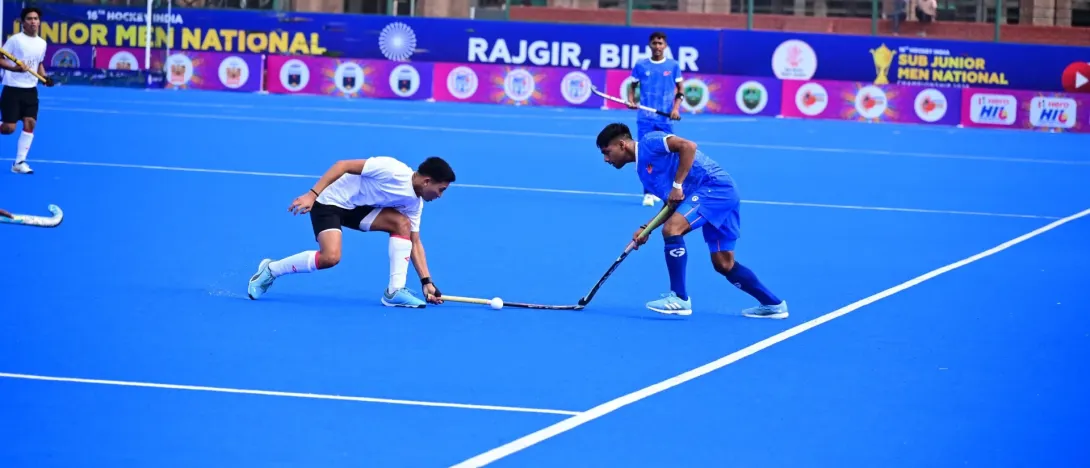
The 16th Hockey India Sub Junior Women National Championship commenced with emphatic performances across divisions at the Rajgir Sports Complex in Rajgir. Teams including Hockey Punjab, Uttar Pradesh Hockey, and Hockey Madhya Pradesh registered commanding victories, highlighting the depth of emerging talent in Indian women’s hockey. The tournament’s opening day also showcased lopsided scorelines, reflecting disparities in team preparedness. Beyond results, the event underscores growing investment in grassroots sports, with long-term implications for India’s hockey ecosystem and sports economy.
Opening Day Sets Competitive Tone
The championship began with high-intensity fixtures in Division A, where established state teams asserted dominance early. Hockey Punjab secured a 2–0 victory over Hockey Maharashtra in Pool A, demonstrating defensive discipline and clinical finishing.
In Pool B, Hockey Jharkhand edged past Dadra & Nagar Haveli and Daman & Diu Hockey with a narrow 1–0 win, reflecting a closely contested encounter. Meanwhile, Pool C witnessed one of the day’s most one-sided matches, as Hockey Madhya Pradesh overwhelmed Manipur Hockey 17–1.
Uttar Pradesh and Bengal Deliver Statement Wins
In Pool D of Division A, Uttar Pradesh Hockey delivered a commanding 10–1 victory against Kerala Hockey, signaling their intent as strong contenders. The team’s attacking efficiency and structured gameplay stood out as key differentiators.
Division B also produced remarkable scorelines, with Hockey Bengal recording an emphatic 18–0 win over Hockey Gujarat in Pool A. Such results highlight both the attacking prowess of leading teams and the developmental gaps that persist in certain regions.
Competitive Balance and Emerging Talent
While some matches were tightly contested, others exposed significant disparities in skill levels and preparation. Hockey Arunachal’s 5–3 win over Chhattisgarh Hockey in Division B, Pool B, provided a more balanced contest, showcasing competitive spirit and tactical resilience.
The tournament serves as a platform for identifying and nurturing young talent, with players gaining exposure to high-pressure match environments. These early performances offer insights into future prospects for India’s national hockey pipeline.
Grassroots Development and Financial Investment
Events such as the Sub Junior Women National Championship are integral to India’s long-term sports development strategy. Investments in grassroots hockey—often running into multiple crores (Rs.) through infrastructure, coaching programs, and talent scouting—are beginning to yield visible outcomes.
State associations and governing bodies are increasingly focusing on structured development pathways, ensuring that emerging players receive the necessary resources to compete at higher levels.
Economic and Strategic Implications
Beyond sporting outcomes, the tournament contributes to the broader sports economy by driving local engagement, tourism, and infrastructure utilization. Hosting events in cities like Rajgir also supports regional development, aligning with national efforts to decentralize sports infrastructure.
The visibility generated by such competitions enhances sponsorship opportunities and strengthens the commercial viability of women’s hockey, a segment gaining increasing attention in India.
Conclusion: A Promising Start with Long-Term Significance
The opening day of the championship has set a compelling tone, marked by dominant performances and emerging rivalries. While disparities in competition remain evident, the overall trajectory points toward growth and increased competitiveness.
As the tournament progresses, it will not only determine champions but also shape the future of Indian women’s hockey—reinforcing the importance of sustained investment, strategic planning, and grassroots development in building a globally competitive sporting ecosystem.
Comments