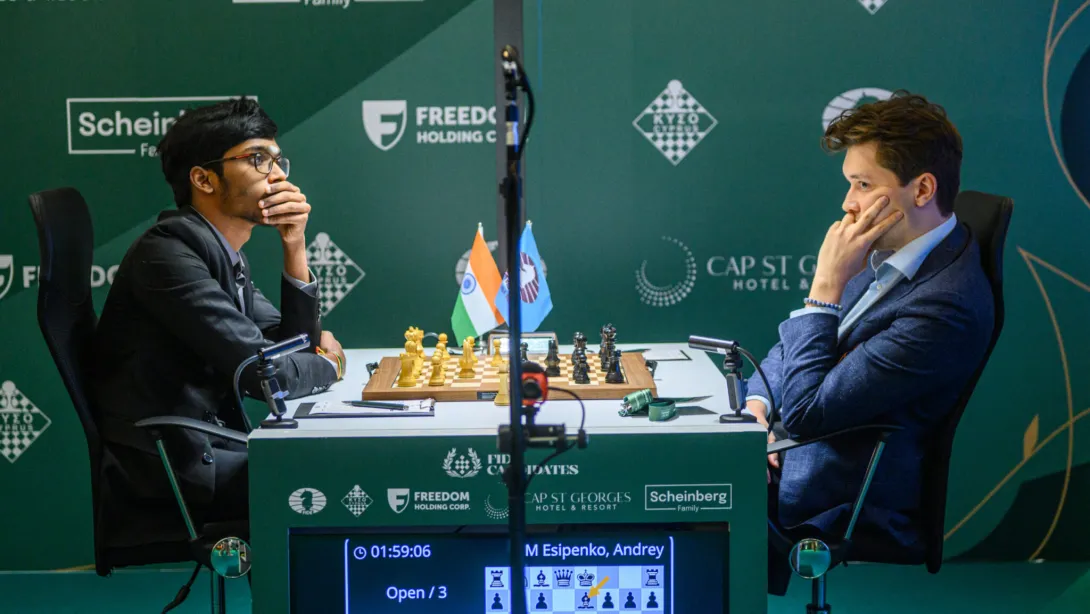
The FIDE Candidates Tournament 2026 has entered a demanding phase for India, with missed opportunities shaping outcomes in both the men’s and women’s sections. In a key encounter, R Praggnanandhaa failed to convert an early advantage against Andrey Esipenko, resulting in a draw after 41 moves. The outcome represents a lost chance to narrow the gap with tournament leaders. As competition intensifies, such marginal setbacks underscore the importance of precision, timing, and strategic execution in elite chess.
A Critical Juncture in the Candidates Tournament
The Candidates Tournament remains one of the most consequential events in global chess, determining the challenger for the World Championship. As the 2026 edition progresses, the fifth round has proven to be a turning point—particularly for Indian contenders seeking to establish momentum.
For India, widely regarded as a rising powerhouse in chess, the round highlighted both potential and the challenges of converting positional advantages into decisive victories.
Praggnanandhaa’s Draw: Opportunity Unfulfilled
R Praggnanandhaa’s encounter with Andrey Esipenko was closely watched, given its implications for the standings. Playing with the white pieces, Praggnanandhaa secured an early positional edge, placing him in a favorable position to press for a win.
However, the advantage proved difficult to translate into concrete gains. Esipenko adopted a resilient and error-free approach, neutralizing threats and maintaining structural balance throughout the game. After 41 moves, the contest concluded in a draw—an outcome that, while respectable, fell short of strategic expectations.
Tactical Analysis: Precision at the Highest Level
At elite levels of chess, the margin between advantage and victory is often razor-thin. Praggnanandhaa’s inability to generate decisive winning chances reflects the defensive solidity displayed by Esipenko.
The game evolved into a balanced middlegame, where neither player could create sufficient imbalances to force a breakthrough. Such scenarios emphasize the importance of converting early initiative into sustained pressure—a hallmark of championship-level play.
Impact on Standings and Competitive Dynamics
The draw carries broader implications for the tournament standings. With leaders maintaining their pace, missed opportunities to secure full points can widen the competitive gap.
For Praggnanandhaa, the result represents a moment of recalibration. While remaining firmly in contention, the need to capitalize on future opportunities becomes increasingly urgent as the tournament progresses.
India’s Position in the Global Chess Ecosystem
India’s strong representation in the Candidates Tournament underscores the country’s growing influence in international chess. Young grandmasters like Praggnanandhaa symbolize a new generation of talent capable of challenging established powers.
However, sustained success at this level requires not only technical excellence but also psychological resilience and strategic clarity—particularly in high-pressure situations where every move carries significant weight.
Conclusion
Round five of the 2026 FIDE Candidates Tournament serves as a reminder of the unforgiving nature of elite chess. For R Praggnanandhaa and India’s broader campaign, the inability to convert promising positions into victories highlights the fine margins that define success. As the tournament advances, the focus will shift toward maximizing opportunities, maintaining composure, and navigating the complexities of top-tier competition with precision and intent.
Comments