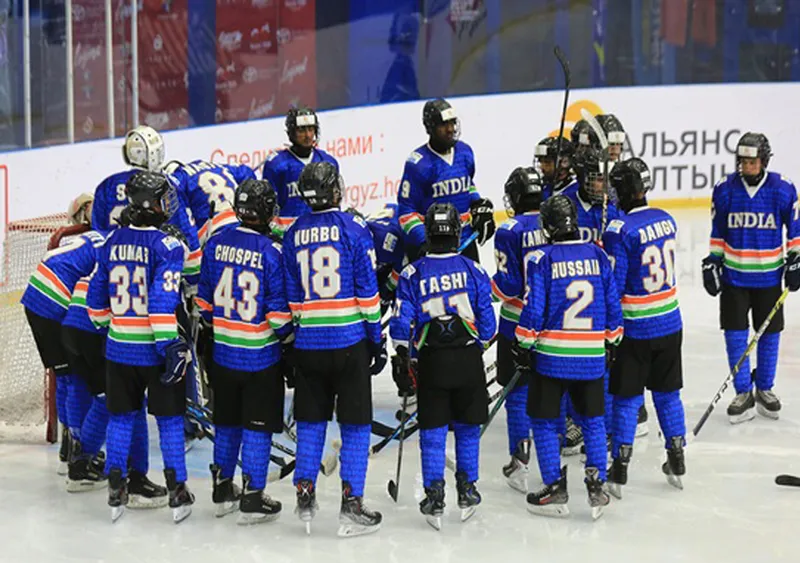
India’s under-18 ice hockey team delivered a commanding performance at the Asia Cup in Bishkek, defeating Macau 8–1 in a statement victory that underscores the nation’s growing presence in non-traditional sports. Led by captain Gurtej Singh Bhatti, who netted four goals, the team demonstrated tactical discipline and offensive precision. The result highlights India’s expanding grassroots development and institutional backing in winter sports, positioning the country as an emerging contender in Asia’s ice hockey landscape while reinforcing broader ambitions to diversify its global sporting footprint.
A Commanding Performance on International Ice
India’s U-18 ice hockey team showcased clinical dominance with an emphatic 8–1 victory over Macau in the Asia Cup. From the opening whistle, India asserted control, dictating pace and maintaining structural discipline across all three periods.
The breakthrough came early, with Ajay Dangi initiating the scoring momentum. The team’s offensive rhythm quickly intensified, overwhelming the opposition with coordinated attacks and efficient finishing. By the final period, India had firmly established superiority, leaving little room for a comeback.
Leadership and Individual Brilliance
At the center of the victory was captain Gurtej Singh Bhatti, whose four-goal performance proved निर्णisive. His ability to convert opportunities under pressure reflected both technical proficiency and strategic awareness.
Bhatti’s leadership extended beyond scoring, as he guided the team’s tempo and ensured consistency throughout the match. Contributions from Itfiqar Hussain, Tanzin Tashi, and Devansh Sharma further underscored the squad’s depth and attacking versatility.
In post-match remarks, Bhatti emphasized the importance of maintaining intensity and adapting swiftly to in-game situations—an approach that enabled the team to strengthen its performance in the latter stages.
Tactical Discipline and Game Management
India’s victory was not solely a product of attacking flair but also of disciplined execution. The team demonstrated effective game management, maintaining possession, minimizing defensive lapses, and capitalizing on scoring opportunities.
A key differentiator was the ability to reassess and recalibrate strategy mid-game. This adaptability allowed India to elevate its performance in the third period, reinforcing its competitive edge and ensuring a decisive outcome.
Such tactical maturity at the junior level signals a positive trajectory for India’s ice hockey program, which has historically operated on the fringes of mainstream sports infrastructure.
Institutional Backing and Growth Trajectory
The performance drew praise from Harjinder Singh, General Secretary of the Ice Hockey Association of India, who highlighted the team’s progress on the international stage.
This recognition reflects broader institutional efforts to strengthen winter sports in India. Investments in training, exposure to international competitions, and grassroots development are gradually yielding results, as evidenced by the team’s cohesive performance.
From a strategic standpoint, success in emerging sports like ice hockey enhances India’s sporting diversification, opening new avenues for sponsorship, infrastructure development, and international collaboration.
Economic and Strategic Implications
While ice hockey remains a niche sport in India, performances of this caliber carry long-term economic implications. Success at international tournaments can attract corporate sponsorships, government funding, and media attention—critical components for scaling the sport domestically.
Moreover, such victories contribute to brand India’s global sporting identity, reinforcing its capability to compete across diverse disciplines. As the sports economy expands, even non-traditional segments are becoming viable investment opportunities.
Conclusion: A Statement Win with Future Promise
India’s 8–1 triumph over Macau is more than a one-off result—it is a reflection of evolving capability and ambition. With disciplined execution, strong leadership, and institutional support, the U-18 team has set a benchmark for future performances.
As the tournament progresses, consistency will be key. However, this victory has already signaled that India’s presence in Asian ice hockey is no longer peripheral but increasingly competitive, marking a significant step in the nation’s broader sporting evolution.
Comments