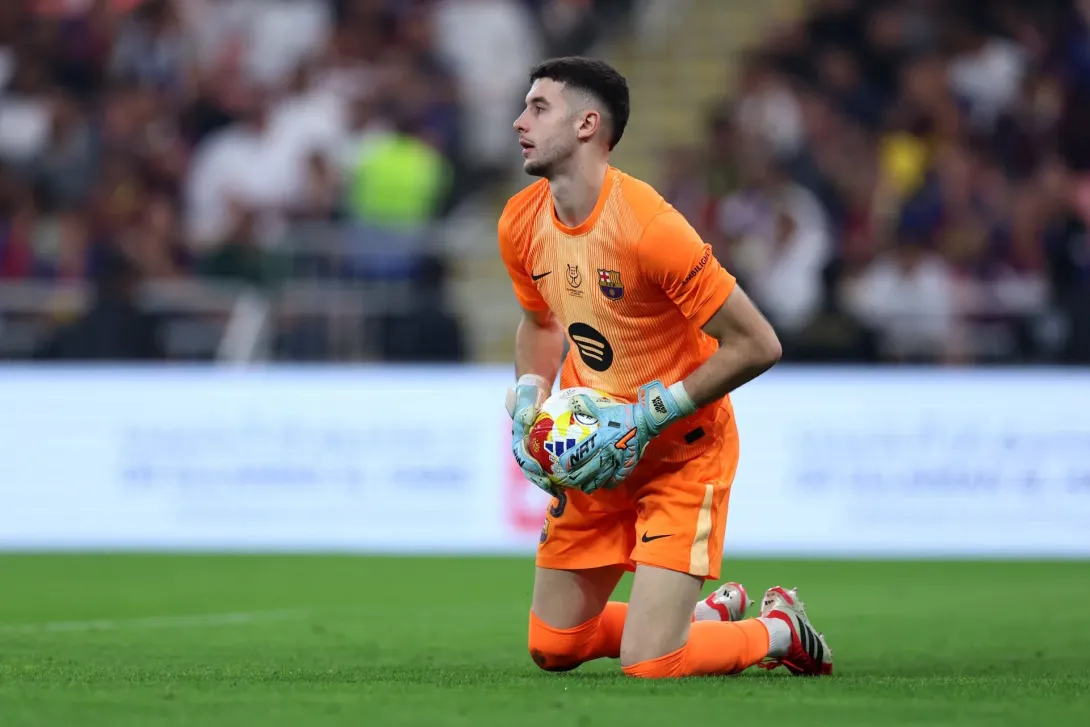
FC Barcelona may have captured headlines for its attacking brilliance this season, but the club’s pursuit of the La Liga title has been equally shaped by defensive resilience and tactical discipline. At the center of that stability stands goalkeeper Joan Garcia, whose consistent performances have elevated him into the leading contender for the prestigious Zamora Trophy, awarded to the league’s best goalkeeper. Despite conceding in Barcelona’s recent 2-1 victory over CA Osasuna, Garcia’s reputation remains firmly intact. His rise reflects both Barcelona’s structural transformation under modern football management and the growing strategic importance of elite goalkeeping in title-winning campaigns.
Barcelona’s Defensive Evolution Shapes the Title Race
Throughout the season, FC Barcelona has earned widespread acclaim for its attacking fluidity, dynamic pressing system, and offensive depth. Yet beneath the goals and spectacle lies a quieter foundation underpinning the club’s title ambitions: defensive consistency.
Barcelona’s ability to control matches has not depended solely on scoring power. Equally important has been the team’s capacity to minimize risk, maintain positional organization, and absorb pressure during decisive moments. That defensive discipline has emerged as one of the defining characteristics of the club’s resurgence.
Central to that structure is goalkeeper Joan Garcia, whose performances have transformed him into one of the most influential figures in Spain’s top division this season.
Despite conceding during Barcelona’s recent 2-1 win over CA Osasuna, Garcia continues to lead the race for the Zamora Trophy — one of Spanish football’s most respected individual honors for goalkeepers.
Joan Garcia’s Rise Reflects Tactical Stability
Garcia’s emergence has coincided with Barcelona’s broader tactical stabilization under its current leadership structure. While attacking players often dominate public attention, modern football increasingly rewards teams capable of sustaining defensive reliability across an entire campaign.
Garcia’s influence extends beyond traditional shot-stopping. Analysts point to his positional awareness, distribution under pressure, command of the defensive line, and composure in transition phases as critical components of Barcelona’s system.
His performances have enabled Barcelona to maintain structural balance even during matches in which the team’s attacking rhythm has fluctuated. In elite football, that reliability often separates title contenders from inconsistent challengers.
The fact that Garcia remains the frontrunner for the Zamora Trophy despite a recent concession against Osasuna underscores the consistency he has displayed over the course of the season rather than the outcome of any single fixture.
The Growing Strategic Value of Elite Goalkeeping
Modern football has increasingly elevated the goalkeeper position from reactive last line of defense to proactive tactical orchestrator. Clubs competing for major trophies now demand far more than reflex saves from their goalkeepers.
Garcia’s season exemplifies that evolution. Barcelona’s defensive setup relies heavily on his ability to initiate build-up play, manage high defensive lines, and maintain composure under aggressive pressing systems.
This tactical sophistication has significantly increased the market value of elite goalkeepers across European football. In today’s transfer economy, top-performing keepers are regarded as long-term strategic assets capable of influencing both sporting outcomes and financial valuation.
For Barcelona, Garcia’s rise arrives at a particularly important time. The club has spent recent years balancing competitive ambitions with financial restructuring efforts. Developing or securing reliable high-level performers internally reduces dependency on expensive transfer-market acquisitions.
Zamora Trophy Race Highlights Defensive Excellence
The Zamora Trophy remains one of the most prestigious individual recognitions in Spanish football, rewarding sustained defensive performance rather than isolated moments of brilliance.
Garcia’s position at the forefront of the race reflects Barcelona’s overall defensive efficiency throughout the campaign. While attacking statistics often dominate headlines, defensive metrics such as save percentage, goals conceded per match, and organizational control frequently determine championship outcomes over a long season.
Football analysts increasingly argue that modern title-winning sides are built on equilibrium rather than spectacle alone. Barcelona’s campaign appears to validate that theory.
The club’s attacking output may have captured public imagination, but its defensive consistency has quietly provided the operational stability required to sustain a prolonged title challenge.
Barcelona’s Broader Sporting and Commercial Recovery
Garcia’s development also aligns with Barcelona’s wider institutional recovery. After enduring periods of financial turbulence and managerial instability, the club has gradually re-established itself as both a competitive and commercially influential force in European football.
Strong defensive organization has become symbolic of that broader transformation. Teams operating under financial scrutiny often prioritize structural efficiency, tactical clarity, and squad balance over short-term star-driven strategies.
Barcelona’s ability to combine attacking entertainment with defensive discipline has strengthened both on-field performance and commercial appeal. Successful title races significantly enhance broadcasting value, sponsorship engagement, and global fan interest.
In elite football’s modern economic environment, sporting stability directly influences institutional revenue generation.
Defensive Reliability May Define the Championship Outcome
As the La Liga season approaches its decisive stages, Barcelona’s pursuit of the title may ultimately depend less on spectacular attacking moments and more on the consistency of its defensive foundation.
Garcia’s performances have become emblematic of that reality. Even in matches where clean sheets disappear, his broader contribution to Barcelona’s tactical structure remains undeniable.
For supporters, the goalkeeper’s emergence offers reassurance that the club possesses the balance required to compete at the highest level. For analysts, it highlights the increasingly sophisticated demands placed upon modern goalkeepers in elite European football.
And for Barcelona itself, Joan Garcia’s rise may represent something even more significant: evidence that sustainable success is being rebuilt not merely through attacking flair, but through institutional stability, tactical discipline, and defensive excellence.
Comments