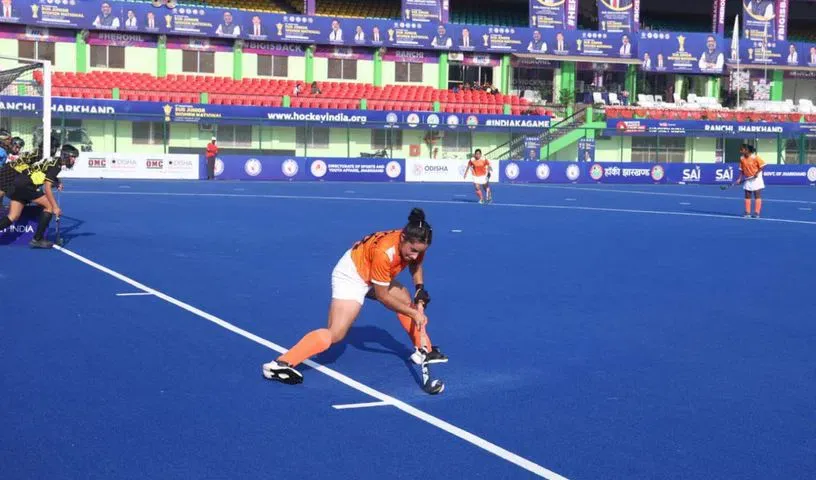
In a compelling story of talent transcending geography, 16-year-old Akshra Dutta from the remote border district of Poonch in Jammu and Kashmir has earned a place in India’s Under-18 National Coaching Camp in Bhopal. Her selection follows a standout performance at the national sub-junior championship, where she emerged as one of the top scorers. Coming from a region with limited sporting infrastructure, Akshra’s achievement underscores both individual resilience and the untapped potential in India’s hinterlands. Her journey reflects broader themes of access, opportunity, and the evolving pipeline of talent feeding into Indian hockey’s national framework.
A Breakthrough from the Borderlands
In a region more often associated with geopolitical tension than sporting excellence, Akshra Dutta’s ascent marks a noteworthy departure. Hailing from Poonch, situated a mere eight kilometers from the Line of Control, the 16-year-old has defied structural limitations to secure a coveted spot in Hockey India’s Under-18 National Coaching Camp.
The camp, currently underway at the Sports Authority of India facility in Bhopal, represents a critical pipeline for grooming future national-level athletes. For Akshra, it is not merely an opportunity but a validation of years of perseverance in an environment where access to professional training remains constrained.
Performance that Demanded Attention
Akshra’s inclusion in the national camp is rooted firmly in merit. At the 16th Hockey India Sub Junior Women National Championship 2026 Division C, she delivered a performance that turned heads across the domestic circuit. Representing Hockey Jammu and Kashmir, she netted four field goals, finishing as the second-highest scorer in her division.
Her offensive consistency proved instrumental in her team’s dominant run. Jammu and Kashmir topped Pool B, earning promotion to Division B—a significant step up in competitive intensity and visibility. Analysts note that such performances not only reflect individual brilliance but also hint at a gradual strengthening of hockey ecosystems in non-traditional regions.
The Structural Challenge of Geography
Athletes emerging from border districts like Poonch often contend with systemic disadvantages—limited infrastructure, fewer professional coaches, and minimal exposure to high-level competition. Unlike metropolitan hubs where sports academies and sponsorship networks are more accessible, regions along the Line of Control operate within a narrower bandwidth of opportunity.
Akshra’s journey, therefore, is as much about navigating these constraints as it is about athletic skill. Her progression highlights a persistent gap in India’s sports development model: the uneven distribution of resources. Yet, it also underscores the effectiveness of national tournaments in identifying and elevating hidden talent.
A Signal for Indian Hockey’s Talent Pipeline
From a broader policy perspective, Akshra’s selection reinforces the importance of decentralized talent scouting. Over the past decade, Hockey India has increasingly relied on national championships to widen its recruitment base. This approach is gradually yielding dividends, with players from remote and underserved regions entering elite training programs.
Her story aligns with a larger trend in Indian sports, where governing bodies are attempting to democratize access and reduce regional disparities. If sustained, such efforts could significantly enhance the depth and diversity of India’s hockey talent pool.
Beyond Selection: The Road Ahead
While entry into the national coaching camp is a significant milestone, it also marks the beginning of a more demanding phase. The training environment at Bhopal is designed to test not only technical ability but also mental resilience, tactical awareness, and physical endurance.
For Akshra, the challenge now lies in translating promise into consistency. Success at this level could open doors to junior national teams and, eventually, senior international representation. More importantly, her journey has already begun to reshape perceptions about where elite athletes can emerge from.
Conclusion
Akshra Dutta’s rise is more than an individual success story; it is a case study in the evolving dynamics of Indian sport. It illustrates how talent, when combined with opportunity—even if limited—can disrupt established narratives. As India continues to invest in its sporting future, stories like hers serve as both inspiration and a reminder: excellence often resides in the most unexpected places, waiting to be discovered.
Comments