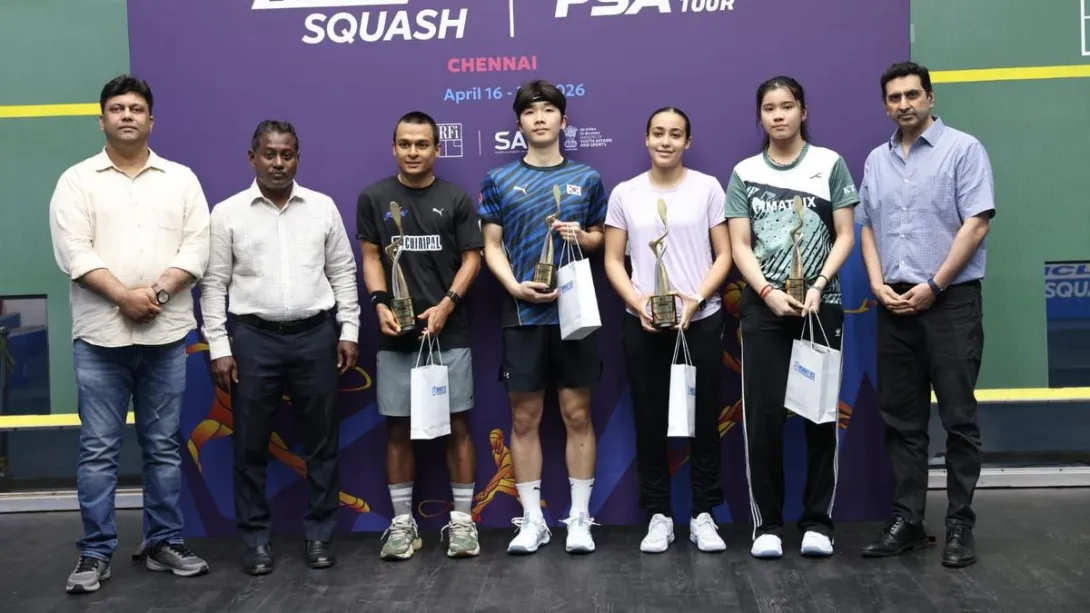
India’s rising squash talent Suraj Kumar Chand delivered a commanding performance to secure the HCL Squash PSA Challenger Tour title in Chennai, defeating South Korea’s Jeongmin Ryu in straight games. The second-seeded Indian, ranked No. 134 globally, showcased tactical precision and composure to clinch his fourth PSA Tour title. In the women’s final, Egypt’s Rouqaia Othman overcame Malaysia’s Harleein Tan in a competitive four-game encounter. The tournament, hosted at the Indian Squash Academy, highlighted emerging global talent and underscored India’s growing stature in professional squash, both as a host nation and a competitive force.
Chand’s Clinical Victory Signals Rising Indian Momentum
At the Indian Squash Academy in Chennai, Suraj Kumar Chand reaffirmed his growing credentials on the professional circuit with a decisive straight-games victory over South Korea’s Jeongmin Ryu. Entering the final as the second seed, Chand displayed remarkable control and strategic clarity, dispatching his eighth-seeded opponent 11-5, 11-9, 11-3.
The result not only secured Chand’s fourth Professional Squash Association (PSA) Tour title but also marked a significant milestone in his steady ascent in global rankings. Currently positioned at World No. 134, Chand’s performance reflects both technical maturity and mental resilience—qualities essential for breaking into the upper echelons of the sport.
Tactical Superiority Defines the Final
Chand’s dominance was evident from the outset. He dictated the tempo of rallies, forcing Ryu into defensive positions and capitalizing on unforced errors. The Indian’s shot selection—particularly his precision drops and tight drives—proved instrumental in maintaining pressure throughout the match.
While the second game offered brief resistance from Ryu, Chand’s composure under pressure ensured he closed it out efficiently. By the third game, the contest had become one-sided, with Chand accelerating to victory in emphatic fashion.
Women’s Final: Othman Overcomes Tan in Hard-Fought Contest
In the women’s draw, Egypt’s seventh seed Rouqaia Othman emerged victorious against Malaysia’s second seed Harleein Tan in a competitive four-game final. Othman secured the title with a 12-10, 11-7, 9-11, 11-7 win, demonstrating both resilience and tactical adaptability.
The match featured intense rallies and momentum shifts, particularly in the third game where Tan mounted a spirited comeback. However, Othman’s ability to recalibrate and assert control in the fourth game ultimately proved decisive.
Chennai Tournament Highlights Global Depth
The HCL Squash PSA Challenger Tour event in Chennai served as a microcosm of the sport’s expanding global footprint. With competitors from Asia, Africa, and beyond, the tournament showcased the increasing depth of talent across regions.
For India, the event represents more than just a home victory. It underscores the country’s growing investment in squash infrastructure and athlete development, positioning it as a key hub in the international squash ecosystem.
Strategic Implications for Indian Squash
Chand’s triumph is emblematic of a broader upward trajectory in Indian squash. As the sport continues to attract corporate sponsorships and institutional backing, performances like these contribute to enhancing its commercial viability and global visibility.
From a business perspective, consistent success at Challenger-level events is critical. It not only improves player rankings but also strengthens the case for hosting higher-tier tournaments, thereby attracting greater investment and audience engagement.
Conclusion
Suraj Kumar Chand’s authoritative victory in Chennai is more than an individual achievement—it is a signal of India’s evolving presence in professional squash. Coupled with strong international participation and competitive women’s fixtures, the tournament reinforces the sport’s dynamic growth. As Indian players continue to climb the ranks, the intersection of performance, infrastructure, and investment will determine how far the nation can go in shaping the future of global squash.
Comments