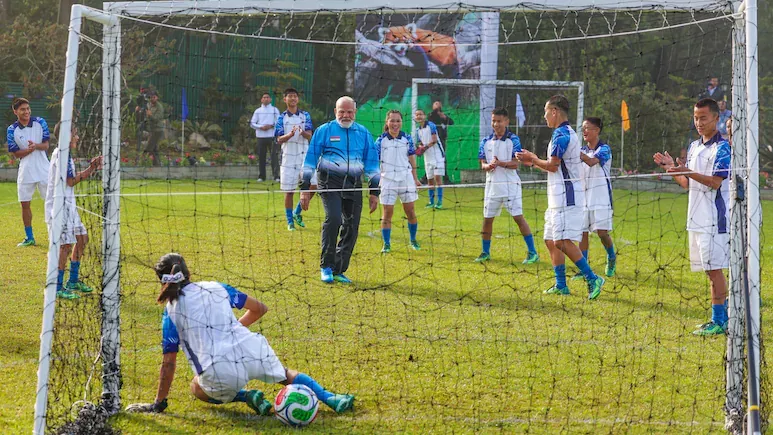
Prime Minister Narendra Modi’s informal football session with youth in Gangtok has drawn attention not only for its symbolism but also for its broader implications for India’s regional sports ecosystem. The interaction highlights the deep-rooted football culture in the northeastern states, where the sport rivals cricket in popularity. Analysts interpret the moment as a strategic endorsement of grassroots engagement and youth development, reinforcing the government’s focus on sports as a vehicle for social and economic growth. The Northeast, long considered a talent reservoir, is increasingly emerging as a critical node in India’s evolving sports economy and development narrative.
A Symbolic Morning in the Hills
Prime Minister Narendra Modi on Tuesday engaged in an informal football session with local youth in Gangtok, describing the experience as both “lovely” and “energising.” Sharing glimpses of the interaction on the social media platform X, the Prime Minister highlighted the vitality and enthusiasm of young players in the region.
Such public engagements, while seemingly casual, often carry deeper policy signaling—particularly in sectors like sports, where grassroots participation forms the backbone of long-term success.
Northeast: India’s Football Stronghold
The Northeast region, including Sikkim, Mizoram, Manipur, and Meghalaya, has long been recognized as a footballing hub. Unlike many other parts of India where cricket dominates, football commands widespread loyalty and participation across these states.
From a socio-economic perspective, this regional preference has contributed to the steady emergence of professional players, local leagues, and football-centric infrastructure. The area is increasingly seen as a high-yield talent market within India’s broader sports economy.
Grassroots Engagement as Policy Signal
The Prime Minister’s interaction with young footballers can be interpreted as a reaffirmation of the government’s emphasis on grassroots sports development. Initiatives aimed at nurturing early-stage talent are central to building a sustainable pipeline of athletes capable of competing on international platforms.
Encouraging youth participation in sports also carries secondary economic benefits, including job creation, regional branding, and increased investment in infrastructure. In this context, symbolic gestures by national leadership often play a catalytic role in shaping public interest and institutional priorities.
Football and the Emerging Sports Economy
India’s sports sector is undergoing a gradual transformation, with football gaining traction alongside traditional strongholds like cricket. The Northeast’s established football culture positions it as a strategic asset in this transition.
As leagues expand and viewership grows, the commercial viability of football is improving. Sponsorship deals, media rights, and grassroots academies are contributing to a more structured ecosystem. The visibility generated by high-profile endorsements—such as the Prime Minister’s participation—further amplifies the sport’s growth trajectory.
Youth, Identity, and Regional Development
Football in the Northeast is more than a sport; it is a cultural identity and a channel for social mobility. For many young athletes, the game represents an opportunity to access professional careers and national recognition.
By engaging directly with youth in Gangtok, Narendra Modi has spotlighted the region’s potential and reinforced its role in India’s sporting future. Such interactions help bridge the gap between policy frameworks and community-level aspirations.
Conclusion
The Gangtok football session may appear informal, but its implications are far-reaching. It underscores the Northeast’s importance in India’s sports landscape and highlights the role of leadership in promoting grassroots engagement.
As India seeks to expand its footprint in global sports, regions like Sikkim and its neighbors are poised to play a pivotal role. Harnessing this potential will require sustained investment, strategic planning, and continued encouragement—both on and off the field.
Comments