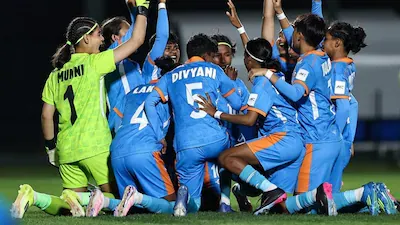
India’s U17 women’s football team delivered a historic performance at the AFC U17 Women’s Asian Cup China 2026, defeating Lebanon women's national under-17 football team 4-0 to secure a maiden quarter-final qualification in the tournament’s history. Led by a brilliant brace from Pritika Barman and additional goals from Alva Devi Senjam and Joya, the Young Tigresses registered India’s first victory and first goals in the competition since 2005. The emphatic result represents a defining milestone for Indian women’s football, highlighting the rapid progress of youth development structures and strengthening optimism surrounding the country’s long-term football ambitions.
India’s U17 Women Rewrite History in China
Indian football witnessed a landmark moment as the nation’s U17 women’s team secured an unprecedented place in the quarter-finals of the AFC U17 Women’s Asian Cup China 2026 with a commanding 4-0 victory over Lebanon women's national under-17 football team.
The victory at the Suzhou Taihu Football Sports Centre marked a breakthrough achievement for India’s youth football ecosystem. Not only did the result guarantee progression to the knockout stage for the first time, but it also ended a two-decade wait for India’s first goals and first win in the competition.
For a nation seeking sustained growth in women’s football, the triumph carries significance far beyond a single tournament result. It reflects years of investment in grassroots development, youth scouting, and the gradual professionalization of the women’s game.
Pritika Barman Leads the Charge
The standout performer of the evening was Pritika Barman, whose clinical finishing and intelligent movement proved decisive in dismantling Lebanon’s defensive structure.
Barman scored twice in a performance that combined composure with attacking aggression, demonstrating the technical maturity increasingly visible within India’s emerging generation of women footballers. Her ability to exploit defensive spaces and maintain efficiency in front of goal gave India the attacking authority that had previously eluded them in the tournament.
Beyond the statistical contribution, her display symbolized the confidence and ambition that defined India’s overall approach throughout the contest.
Collective Team Performance Signals Tactical Growth
While Barman’s brace attracted deserved attention, India’s victory was ultimately built on a disciplined collective effort. Goals from Alva Devi Senjam and Joya further highlighted the team’s attacking depth and growing tactical cohesion.
India controlled the tempo of the match effectively, displaying improved ball circulation, defensive organization, and structured pressing — qualities that reflect a more sophisticated footballing identity within the youth setup.
The side maintained composure both in possession and during transitional phases, preventing Lebanon from establishing sustained attacking pressure. Such maturity at the U17 level suggests encouraging progress in the country’s developmental framework.
A Landmark Achievement for Indian Women’s Football
India’s qualification for the quarter-finals represents one of the most important milestones in the history of the nation’s youth women’s football program.
The achievement acquires additional significance considering the historical context. Before this campaign, India had not registered a victory or even scored a goal in the AFC U17 Women’s Asian Cup since 2005. Breaking both barriers in emphatic fashion underscores the extent of the transformation underway within the system.
In global football, youth tournaments often serve as indicators of long-term structural progress rather than isolated success stories. India’s advancement suggests that developmental investments made over recent years are beginning to yield measurable competitive outcomes.
Rising Investment in Women’s Football Begins to Show Results
The broader implications of India’s success extend into the evolving business and administrative landscape of Indian football.
Women’s football in India has increasingly benefited from greater institutional focus, corporate sponsorship interest, and enhanced developmental infrastructure. Federations and clubs have expanded grassroots initiatives, coaching programs, and scouting mechanisms aimed at identifying talent earlier and creating sustainable player pathways.
Success at international youth tournaments strengthens the commercial and strategic case for continued investment. Strong performances not only increase visibility for women’s football but also improve opportunities for sponsorship, media engagement, and long-term ecosystem development.
India’s quarter-final qualification could therefore become a catalyst for deeper institutional commitment toward women’s football at both domestic and international levels.
Youth Development Emerging as a Strategic Priority
India’s performance in China also reflects a growing recognition that sustainable football progress depends heavily on youth development rather than short-term results.
The tactical discipline and technical confidence displayed by the Young Tigresses indicate that coaching structures at junior levels are gradually becoming more aligned with international standards. Exposure to elite competition at an early stage is essential for producing players capable of succeeding consistently on the continental stage.
As Asian football becomes increasingly competitive, nations that invest strategically in youth systems are likely to gain long-term advantages. India’s emergence in the U17 category suggests the country may finally be building the foundational depth required to compete more regularly at elite tournaments.
Quarter-Final Qualification Sparks New Optimism
For Indian football supporters and administrators alike, the result offers more than celebration — it provides tangible evidence that progress is possible through sustained planning and investment.
The Young Tigresses have not only secured a historic quarter-final berth but also reshaped perceptions regarding India’s potential in women’s football. Their campaign has demonstrated resilience, tactical growth, and attacking ambition, qualities essential for long-term success in international competition.
As India advances into the knockout stage of the AFC U17 Women's Asian Cup China 2026, attention will now shift toward whether this talented generation can continue its remarkable journey.
Regardless of future results, the victory over Lebanon has already established itself as a defining chapter in the evolution of Indian women’s football.
Comments