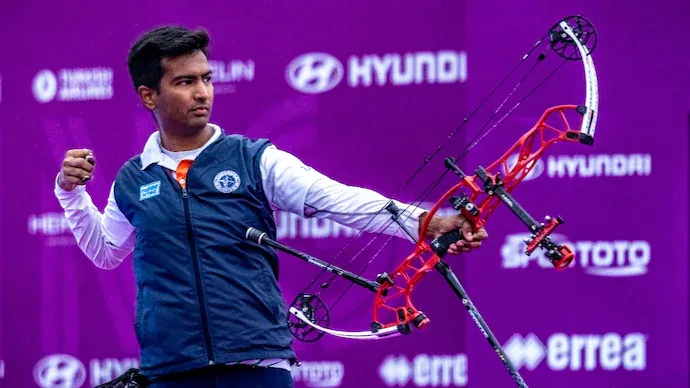
Indian archery continues to be shaped by established names such as Deepika Kumari, Atanu Das, and Jyothi Surekha Vennam, who have consistently defined the country’s presence on the global stage. Deepika remains a symbol of composure and consistency under pressure, while Jyothi has emerged as a leading force in India’s compound archery success story. Alongside them, young archer Rishabh Yadav represents a new wave of talent injecting energy and optimism into the sport. Despite steady progress across disciplines, India’s archery ecosystem continues to face one unresolved ambition: translating global promise into Olympic success, a milestone that remains elusive despite decades of competitive growth and international recognition.
Established Icons Continue to Define Indian Archery
Indian archery’s identity has long been anchored by a small but highly influential group of elite performers.
Deepika Kumari remains one of the most recognizable names in global archery, known for her technical precision and ability to perform under pressure. Her consistency over multiple international cycles has made her a cornerstone of India’s recurve ambitions.
Alongside her, Atanu Das has played a significant role in shaping India’s competitive presence in men’s recurve archery, contributing to key team performances at global tournaments.
In the compound discipline, Jyothi Surekha Vennam has emerged as a defining figure, symbolizing India’s growing dominance in the format and helping establish the country as a consistent contender in world championship events.
Together, these athletes form the backbone of India’s modern archery identity.
Rishabh Yadav: A Fresh and Promising Presence
Amid these established figures, Rishabh Yadav represents the sport’s emerging generation.
With his youthful energy and confident demeanor, Rishabh brings a renewed sense of optimism to Indian archery. His presence reflects the gradual but steady infusion of young talent into a system that has traditionally relied on a small pool of elite performers.
While still in the early stages of his international journey, his growing visibility signals a broader shift toward generational transition within the sport. His approach reflects both technical development and the psychological freshness often associated with rising athletes.
India’s Persistent Olympic Challenge
Despite consistent success across World Cups, Asian Championships, and other international competitions, Indian archery continues to face one significant gap: Olympic conversion.
While athletes such as Deepika Kumari and Atanu Das have delivered strong performances on the global stage, the Olympic podium remains an elusive target.
This gap is not necessarily reflective of talent deficiency, but rather highlights the intense competitiveness and psychological demands of Olympic-level competition. Margins are minimal, and performance consistency under extreme pressure often determines outcomes more than technical skill alone.
The challenge, therefore, is as much structural and psychological as it is technical.
Growth of Compound Archery as a Strategic Strength
One of the most significant developments in Indian archery has been the rise of the compound discipline, led prominently by Jyothi Surekha Vennam.
Compound archery has provided India with a more stable medal-winning platform at international events, allowing the country to expand its competitive footprint beyond recurve events.
Jyothi’s success has not only elevated India’s global standing but also helped diversify the sport’s internal ecosystem, encouraging greater participation and investment in non-recurve categories.
This diversification is increasingly seen as critical to India’s long-term success in global archery.
A Sport in Transition: Blending Experience and Youth
Indian archery is currently navigating a transitional phase where experienced athletes and emerging talent coexist within the same competitive framework.
The presence of veterans like Deepika Kumari alongside rising names such as Rishabh Yadav reflects a balanced ecosystem in evolution.
This blend of experience and youth is essential for sustained international success, particularly in a sport where precision, mental strength, and consistency are critical determinants of performance.
The transition also signals a long-term strategic shift toward building depth beyond a handful of star performers.
The Road Ahead: Converting Promise Into Olympic Success
While Indian archery has achieved significant progress over the past decade, the ultimate benchmark remains Olympic success.
The challenge lies in converting consistent international performance into podium finishes at the highest level of global competition. This requires not only technical refinement but also enhanced exposure to high-pressure environments and sustained mental conditioning.
With athletes like Deepika Kumari, Atanu Das, Jyothi Surekha Vennam, and emerging talents such as Rishabh Yadav, India’s archery ecosystem appears well-positioned for future breakthroughs.
However, the defining question remains whether this blend of talent can finally translate into Olympic success—a milestone that continues to shape the narrative of Indian archery’s long and evolving journey.
Comments