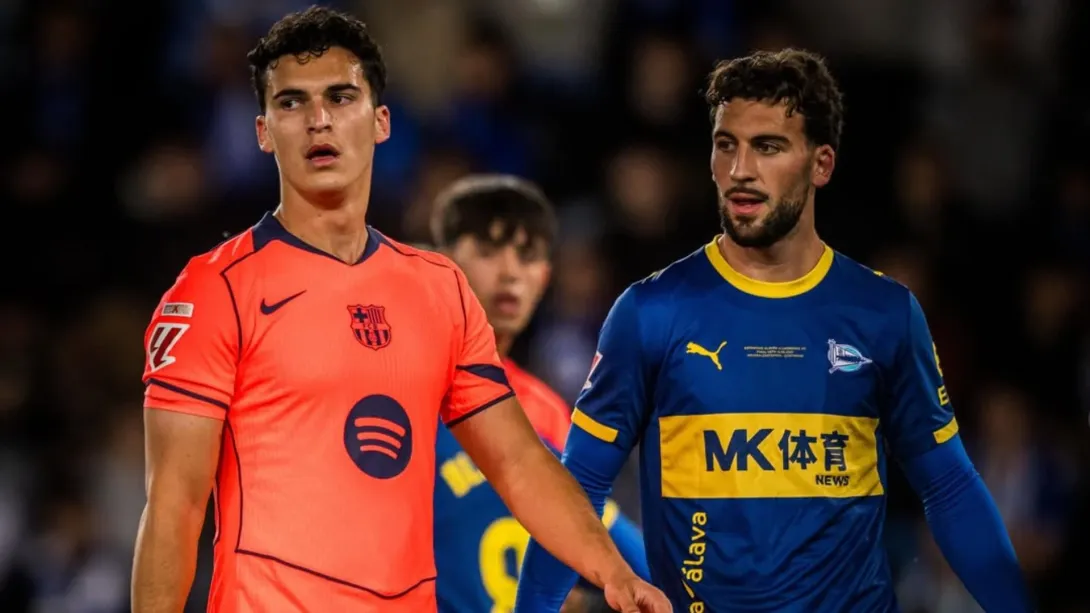
Hansi Flick appears to have identified another promising young prospect capable of contributing to FC Barcelona’s evolving project, following defender Alvaro Cortes’s impressive senior debut against Deportivo Alavés. Reports from Spanish media suggest Flick was highly encouraged by the youngster’s composure and tactical discipline, increasing the likelihood of Cortes being included in Barcelona’s pre-season preparations for next season. The development aligns with the club’s broader strategy of integrating academy talent into the first team amid financial restructuring and squad modernization. Barcelona’s continued reliance on youth development is becoming central to both its sporting identity and long-term economic sustainability.
Flick Continues Barcelona’s Tradition of Trusting Young Talent
The arrival of Hansi Flick at FC Barcelona has increasingly signaled a managerial philosophy built around tactical discipline, positional intelligence, and trust in emerging talent.
That approach appears to have found another beneficiary in Alvaro Cortes, whose recent appearance against Deportivo Alavés reportedly left a strong impression on the German coach.
According to reports emerging from Spain, Flick viewed the young central defender’s performance positively, particularly his composure under pressure, defensive awareness, and ability to adapt quickly to the demands of senior-level football.
The performance has reportedly elevated Cortes into serious consideration for Barcelona’s upcoming pre-season plans, a development that could mark the beginning of a significant breakthrough within the club’s senior structure.
Barcelona’s Financial Reality Reinforces Youth Strategy
The growing emphasis on academy players is not merely a sporting preference for Barcelona — it is increasingly an economic necessity.
Over recent years, the Catalan club has faced persistent financial pressures, forcing management to adopt a more sustainable operational model centered around wage control, talent development, and long-term asset creation. Within that framework, promoting young players from the academy system offers both competitive and financial advantages.
Developing internally produced talent reduces transfer expenditure while simultaneously strengthening squad depth and preserving the club’s traditional footballing identity.
The emergence of players like Alvaro Cortes therefore represents more than a tactical success story. It reflects a broader institutional strategy aimed at balancing sporting competitiveness with economic discipline.
Hansi Flick’s Influence on Squad Evolution
Since taking charge, Hansi Flick has been widely expected to bring greater structural organization and tactical intensity to Barcelona’s setup.
Known for his success in Germany, Flick has built a reputation for integrating younger players into high-performance systems without compromising competitive standards. His coaching philosophy typically emphasizes positional flexibility, intelligent pressing structures, and technical consistency — qualities that align naturally with Barcelona’s traditional football culture.
Observers believe Flick’s willingness to evaluate academy prospects closely could create new opportunities for emerging players within the club’s development pipeline.
For young defenders such as Cortes, early exposure to senior football under a tactically demanding coach may significantly accelerate progression.
Alvaro Cortes Gains Momentum at a Crucial Stage
For Alvaro Cortes, the timing of this breakthrough opportunity could prove particularly important.
Barcelona’s defensive structure is currently undergoing gradual transition, with the club balancing experienced internationals alongside younger developmental prospects. In such an environment, reliable academy defenders capable of adapting quickly to senior football become strategically valuable assets.
Reports suggesting Cortes may travel with the first team during pre-season indicate that the coaching staff sees long-term potential rather than viewing his debut as an isolated appearance.
Pre-season integration at Barcelona often serves as an important evaluation phase, giving coaching staff extended opportunities to assess tactical understanding, physical readiness, and psychological maturity.
La Masia’s Continuing Strategic Importance
The emergence of another academy prospect also reinforces the enduring significance of Barcelona’s famed development system.
La Masia has historically served as one of world football’s most productive talent factories, producing generations of technically refined players who shaped both club and international football.
While Barcelona has experienced periods of heavy external recruitment in recent years, financial realities and sporting recalibration have renewed focus on internal development pathways.
Analysts believe the club’s future competitiveness may depend heavily on its ability to consistently integrate academy graduates into the senior team while avoiding unsustainable spending patterns in the transfer market.
A Strategic Blend of Development and Stability
Barcelona’s current trajectory suggests a deliberate attempt to combine immediate competitiveness with long-term squad sustainability.
Rather than relying exclusively on expensive transfer activity, the club appears increasingly focused on creating a balanced structure where experienced players coexist alongside carefully developed youth talent.
In that context, the rise of Alvaro Cortes may symbolize more than the emergence of another promising defender. It may reflect the broader direction of a club attempting to rebuild both financially and competitively through disciplined planning and institutional continuity.
For FC Barcelona, the success of that model could ultimately define the next phase of its European ambitions.
Comments