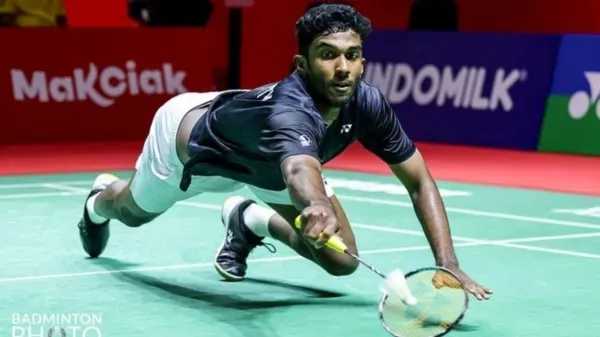
Indian badminton prospect Ayush Shetty is emerging as a distinctive force in international sport, with his exceptional physical attributes playing a central role in his playing identity. Standing at 6 feet 4 inches (1.95 metres), he is among the tallest athletes in elite badminton, using his height to generate steep attacking angles and dominate aerial exchanges. His reach and elevation allow him to apply sustained offensive pressure, making him a difficult opponent in fast-paced rallies. As modern badminton increasingly rewards biomechanical efficiency, Shetty’s profile highlights the growing intersection of physical advantage, tactical evolution, and performance science in elite competition.
A Distinct Physical Profile in Modern Badminton
Ayush Shetty’s emergence on the international badminton circuit has drawn attention largely due to his rare physical attributes. At 6 feet 4 inches (1.95 metres), the Karnataka-born shuttler stands well above the average height seen in elite badminton, a sport traditionally dominated by shorter, agility-focused players.
This difference in stature is not merely a statistical anomaly—it is increasingly shaping his identity as a competitor and influencing the strategic framework of his game.
Turning Height into a Tactical Weapon
In high-performance badminton, height can be a decisive asset when effectively integrated into technical execution. Shetty utilizes his elevated reach to generate steep shuttle trajectories, forcing opponents into defensive positions from the outset of rallies.
His ability to strike from a higher contact point reduces reaction time for rivals and increases court pressure, particularly during attacking exchanges. This allows him to dictate tempo and shift momentum early in points, a key advantage in elite-level matches where margins are minimal.
An Aggressive Playing Philosophy
Beyond physical advantages, Shetty is recognized for his assertive playing style. His approach prioritizes attack-oriented shot selection, with a focus on maintaining offensive control rather than prolonged defensive exchanges.
This mindset aligns with modern badminton trends, where rapid point construction and aggressive positioning are increasingly favored over traditional endurance-based strategies.
The Role of Biomechanics in Elite Sport
Contemporary badminton is undergoing a transformation driven by sports science and performance analytics. Biomechanics now plays a crucial role in optimizing player output, particularly in areas such as reach efficiency, shuttle angle creation, and movement economy.
Shetty’s physical build provides inherent advantages in these areas, but experts emphasize that sustained success depends on balancing height with agility, endurance, and injury management.
India’s Expanding High-Performance Ecosystem
The rise of players like Shetty reflects the broader evolution of India’s badminton infrastructure. Improved coaching systems, access to international training methods, and data-driven performance analysis have enabled athletes with diverse physical profiles to thrive.
This shift marks a departure from conventional talent models, signaling a more holistic approach to athlete development that values both physical attributes and technical adaptability.
Outlook: Converting Potential into Consistency
While Shetty’s physical advantages offer a strong foundation, the next phase of his development will depend on consistency, tactical refinement, and mental resilience under pressure.
In the increasingly competitive landscape of international badminton, natural attributes alone are insufficient. However, when combined with disciplined training and strategic evolution, they can become defining assets. For Ayush Shetty, the challenge now lies in transforming physical potential into sustained elite performance.
Comments