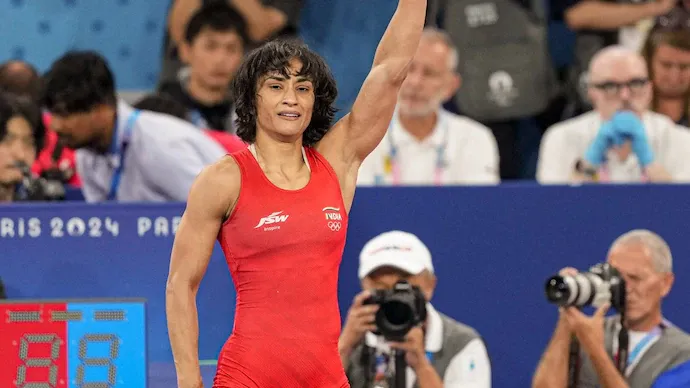
Olympian Vinesh Phogat has escalated tensions with the Wrestling Federation of India (WFI) after posting a cryptic message on social media following her exclusion from the National Open Ranking tournament. The development has reignited debate surrounding athlete governance, administrative transparency, and the ongoing friction between India’s wrestling establishment and some of its most prominent athletes. While the WFI’s decision has drawn significant attention within sporting circles, Vinesh’s public response suggests the confrontation is far from over. The episode highlights deeper institutional challenges within Indian wrestling and raises broader questions about athlete representation, federation authority, and the future direction of governance in Indian sport.
Vinesh Phogat Signals Defiance Amid Fresh Wrestling Controversy
Indian wrestling star Vinesh Phogat has once again become the center of a major sporting controversy after responding publicly to her exclusion from the National Open Ranking tournament by the Wrestling Federation of India.
The Olympian posted a cryptic message on social media shortly after the federation barred her from participating in the competition, a move that immediately triggered speculation regarding the worsening relationship between the athlete and the governing body.
Although Vinesh did not directly reference federation officials in her message, the tone of the post strongly suggested resistance rather than retreat. The response was widely interpreted as an indication that the decorated wrestler is prepared to continue challenging decisions made by the WFI despite mounting institutional pressure.
The latest development adds another layer to an already tense relationship between elite wrestlers and wrestling administrators in India.
WFI Decision Reignites Governance Debate
The Wrestling Federation of India’s decision to prevent Vinesh Phogat from competing has intensified ongoing discussions regarding governance standards and athlete treatment within Indian wrestling.
Ranking tournaments hold substantial importance in the competitive structure of the sport, influencing national selection pathways, performance evaluation, and future international opportunities. Exclusion from such events therefore carries implications beyond a single competition.
The federation’s move has prompted questions from observers regarding procedural transparency, communication mechanisms, and the broader management culture surrounding elite athletes.
In recent years, Indian wrestling has repeatedly found itself at the center of public disputes involving administration, athlete welfare, and institutional accountability. The latest standoff involving one of the country’s most recognizable wrestlers is likely to further amplify scrutiny surrounding the federation’s functioning.
Vinesh Phogat Remains One of India’s Most Influential Athletes
Vinesh Phogat occupies a unique position within Indian sport.
Beyond her achievements on the mat, she has emerged as one of the most visible and outspoken athlete voices in the country, particularly on issues involving athlete rights, governance accountability, and institutional fairness.
Her prominence means that disputes involving her frequently extend beyond wrestling itself, often becoming broader conversations about power structures in Indian sport.
Over the past several years, Vinesh has cultivated an image of resilience and confrontation against systems she believes operate unfairly. As a result, even cryptic public statements from her social media accounts tend to generate substantial public and media attention.
The latest message appears to reinforce that identity, signaling that she does not intend to withdraw quietly from conflict with federation authorities.
Social Media Increasingly Shapes Sporting Power Dynamics
The incident also highlights the growing role of social media in modern sports governance disputes.
Athletes today possess direct communication channels capable of influencing public opinion instantly, reducing the traditional control sporting federations once exercised over narratives and information flow.
Vinesh’s cryptic message quickly became a focal point of discussion precisely because of her stature and public credibility among supporters. Without issuing a detailed statement, she succeeded in drawing attention to the broader issue and reframing the conversation around resistance and accountability.
This shift reflects a larger transformation in professional sports globally, where athletes increasingly leverage digital platforms not only for branding purposes but also for institutional and political expression.
For sports administrators, such dynamics create additional pressure, as public sentiment can rapidly shape the perception of governance decisions.
Wrestling in India Continues to Face Institutional Challenges
Indian wrestling remains one of the country’s most successful Olympic disciplines, yet the sport has repeatedly faced administrative turbulence that threatens to overshadow athletic achievement.
Recurring disputes involving federation management, athlete protests, selection controversies, and governance practices have created an atmosphere of instability within the sport’s ecosystem.
For athletes preparing for elite international competition, prolonged uncertainty can become professionally damaging, affecting training continuity, mental preparation, sponsorship confidence, and career planning.
The situation involving Vinesh Phogat therefore carries significance beyond individual disagreement. It reflects deeper structural tensions regarding authority, transparency, and athlete participation in decision-making processes within Indian sports administration.
Commercial and Reputational Impact Cannot Be Ignored
The controversy also carries broader reputational implications for Indian wrestling at a time when the country continues investing heavily in Olympic sports infrastructure and international sporting ambitions.
High-profile public disputes between elite athletes and governing bodies can influence sponsor sentiment, commercial partnerships, and international perception of administrative stability.
Athletes such as Vinesh Phogat are not only competitors but also commercially valuable public figures whose influence extends into brand endorsements, public campaigns, and sports promotion initiatives.
Consequently, prolonged institutional conflict risks damaging both the federation’s public image and the broader credibility of Indian wrestling governance structures.
In modern sport, reputation management increasingly forms a critical component of organizational effectiveness.
Future of the Dispute Remains Uncertain
At present, it remains unclear whether the situation between Vinesh Phogat and the Wrestling Federation of India will escalate further or move toward resolution.
However, her latest public response strongly indicates that she is unlikely to step away from confrontation without challenging the federation’s position.
For Indian wrestling authorities, the issue now extends beyond a single athlete’s tournament participation. It has evolved into a broader public debate involving governance legitimacy, athlete empowerment, and institutional accountability.
As attention surrounding the controversy continues to grow, both sides are likely to face increasing pressure from supporters, media observers, and the wider sporting community.
In the modern era of elite sport, administrative disputes rarely remain confined behind closed doors — particularly when one of India’s most recognizable athletes is involved.
Comments